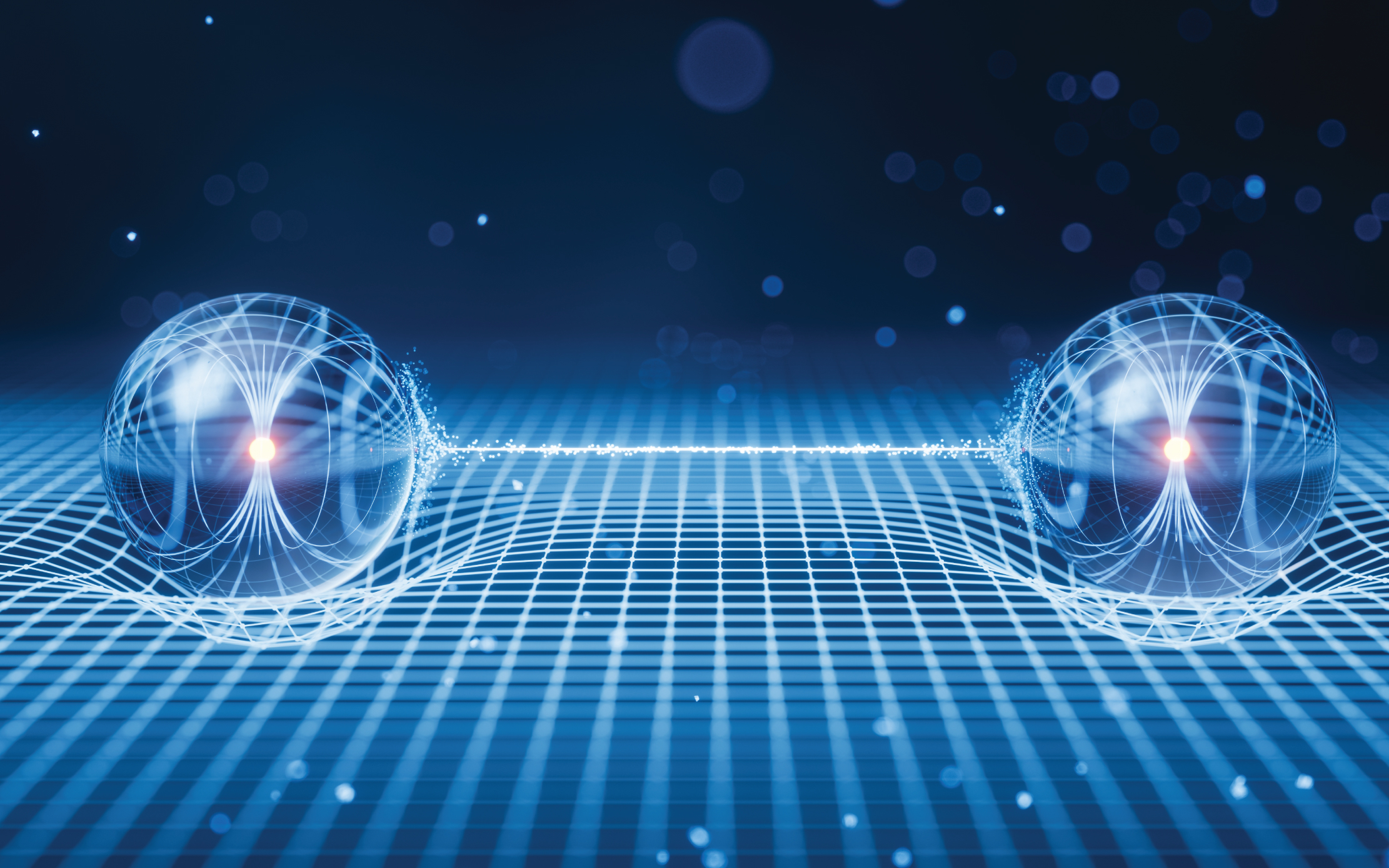
Imagine a pair of six-sided dice with a strange connection between them; their face-up numbers always match, even if each dice is rolled at opposite ends of the Earth. While a link like that might sound like science fiction, it does describe a genuine effect in reality—at least at the quantum scale.
“There’s a phenomenon called quantum entanglement: where two particles are linked so deeply that measuring the properties of one immediately tells you something about the other, even across vast distances,” explained Yunlong Xiao, a Senior Scientist at the A*STAR Institute of High Performance Computing (A*STAR IHPC) and A*STAR Quantum Innovation Centre (A*STAR Q.InC).
Entanglement isn’t just a curiosity, but a potential foundation for quantum computing, ultra-secure quantum communications and and other future technologies. As such, Xiao and a group of collaborators from Shanghai Jiao Tong University, Peking University and Capital Normal University in China; and Stony Brook University, US, have been studying entanglement’s role in the broader picture of how quantum systems share and conserve information.
“A quantum system exhibits a duality of wave-like and particle-like properties when observed and is often entangled with other systems that store information about it. Those other systems act as ‘quantum memory’; the equivalent of a computer’s hard drive for quantum information,” said Xiao. “It’s important to figure out just how entanglement affects quantum memory, because it influences how well quantum information can be shared or protected, and therefore the reliability of information storage, transfer and retrieval in quantum networks and computing systems.”
In a recent study, Xiao and colleagues proposed through a mathematical framework that a triad of quantum system properties—its entanglement, degree of wave-like nature, and degree of particle-like nature—were in fact intertwined and would sum up to a constant through a set of universal conservation laws.
“Our theory started with a simple question: if light and matter can behave both like waves and particles, what happens when they are also entangled with another system?” said Xiao.
To test their proposal, the team designed a silicon quantum chip that produced wave-like and particle-like photons, as well as those with in-between properties. The chip allowed them to observe how wave and particle behaviours changed with varying levels of entanglement between photons.
“What we found was remarkable: as photons became more entangled, their individual wave or particle character diminished, but the overall balance among the three quantities stayed fixed, as our theory predicted,” Xiao said. “This experiment not only confirmed the universal conservation laws, but also showcased how integrated photonic chips can serve as powerful quantum ‘laboratories on a chip’.”
Xiao is optimistic that their work will help bridge the gap between abstract quantum theory and future quantum technologies. For now, the team continues to explore the extension of these conservation principles to larger and noisier quantum systems in real-world operational settings, as well as their implementation on advanced photonic and cold-atom platforms.
“Ultimately, this line of research aims to make quantum technologies not only more powerful, but also more controllable and scalable,” Xiao concluded.
The A*STAR-affiliated researchers contributing to this research are from the A*STAR Institute of High Performance Computing (A*STAR IHPC) and A*STAR Quantum Innovation Centre (A*STAR Q.InC).