


Calculating the path of one billiard ball across an empty table is mathematically straightforward. But strike a full rack of balls, each instantly colliding and altering the others' paths, and the table rapidly descends into chaos. Factor in the messy realities of the real world—felt friction, microscopic dents, tiny imperfections in the equipment—and you'll likely need a computer’s help.
Quantum physicists face the same problem at a much greater scale when predicting what happens to groups of quantum particles in quantum systems, thanks to the strange and random behaviours of matter at a quantum level. Heat, vibrations and other environmental noise can disrupt these delicate systems instantly, scrambling the valuable information they contain. Yet, interactions between them and their surrounding environment are often unavoidable, and when multiple quantum particles are involved, their collective behaviour can rapidly become too complex for even the most powerful conventional computers to simulate.
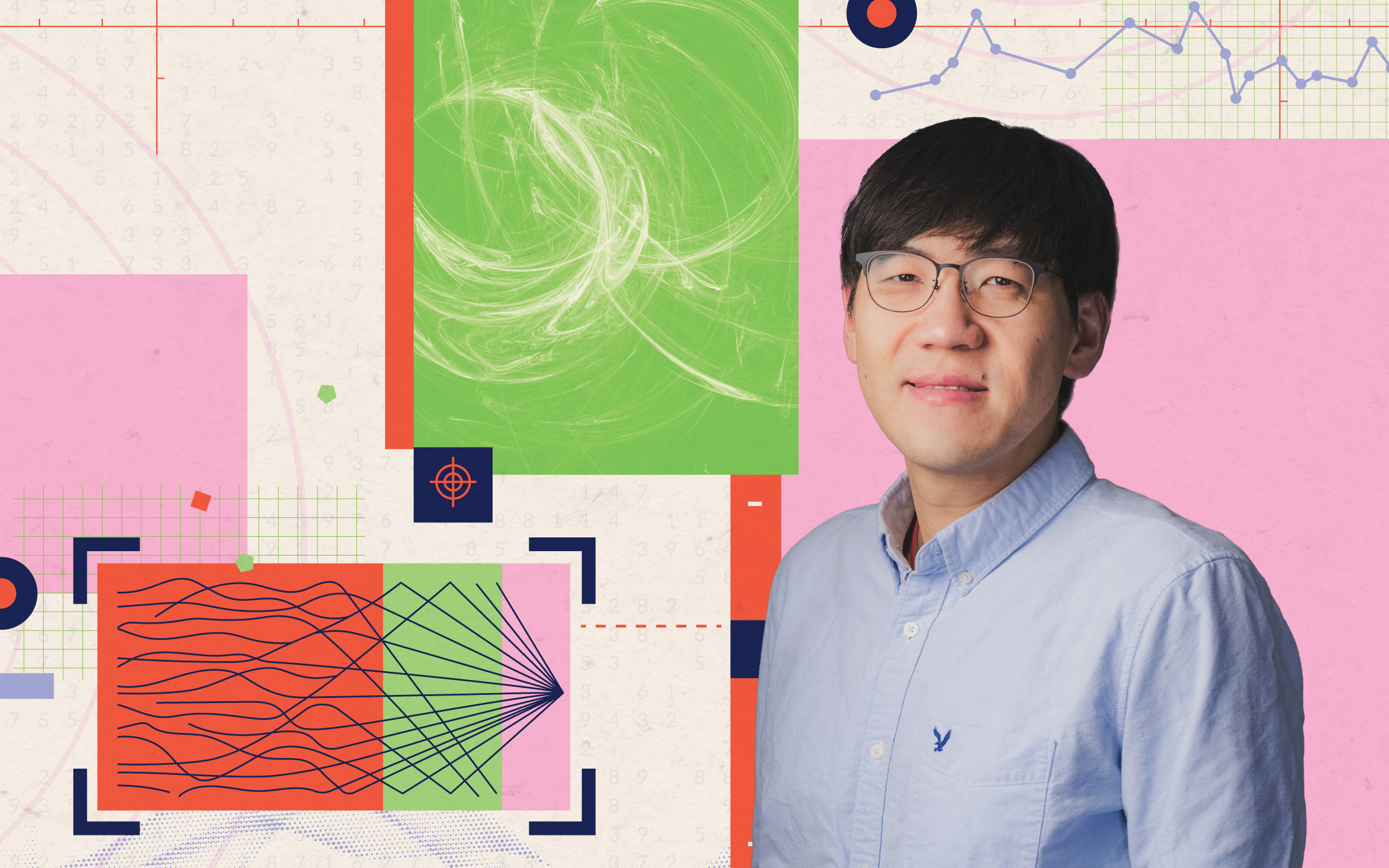
Bo Xing, an A*STAR International Fellowship (AIF) scholar and postdoctoral fellow at the Massachusetts Institute of Technology (MIT), has shaped his career around this challenge—developing computational approaches that track how information moves through complex many-body quantum systems as they interact with their environments, bridging the gap between idealised models and experimentally realistic conditions. Such tools would enable more accurate predictions of how quantum systems behave, opening the door for more robust quantum technologies in precision sensing and information processing.
In this A*STAR Research feature, Xing reflects on his journey into quantum physics, discusses how scientific understandings of quantum entanglement have evolved, and shares his perspectives on the future of quantum computation.
1. Tell us about your journey into science.
My interest in physics and engineering began in my first year of junior college, thanks to a charismatic and devoted physics teacher. In one lecture, he showed the class a slow-motion video of his son tripping and falling, then turned it into a lesson on dynamics by tracing his son’s centre of gravity with free-body diagrams. It was a humorous and illuminating lecture, and it shaped my impression of physics as something fun, intriguing and deeply connected to everyday life.
Motivated by the desire to better understand the physical world around us, I enrolled at the Singapore University of Technology and Design (SUTD), initially choosing engineering because I wasn’t sure pure physics was the right fit. There, I worked with Dario Poletti on many-body quantum systems out of equilibrium. The unintuitive yet elegant nature of quantum physics immediately captivated me; because many-body quantum systems are often too complex to solve analytically, I became increasingly drawn to computational physics as a tool with which to understand complex quantum phenomena.
2. How has that journey shaped your development as a researcher?
My trajectory was not strictly predetermined, but on hindsight, it formed a coherent progression. I obtained an engineering degree, pursued a theoretical PhD degree in many-body quantum systems, and am now a theory postdoctoral fellow in an experimental group at MIT, supported by the AIF. One reason I chose SUTD was its collaboration with MIT, though I didn’t expect that connection to become personally meaningful later.
SUTD’s multidisciplinary curriculum and its focus on hands-on, project-based learning exposed me to both theory and the practical applications thereof. While I’m more drawn to the former, this exposure gave me a deeper appreciation for how applied work grounds and guides theoretical thinking. It shaped my problem-solving approach and encouraged me to think carefully about how to bridge experiment and theory. This perspective naturally motivated and eased my transition into a theory-focused role within an experimental group; a transition that would have been much more challenging without that foundation.
3. Tell us about a piece of research you’re especially proud of.
I’m particularly proud of our recent paper on how quantum entanglement behaves when a system interacts with its environment. In recent years, researchers have discovered that a quantum system ‘measured’ by its environment can undergo an entanglement phase transition when the rate of that measurement crosses a critical threshold. Below that threshold, the system can remain highly entangled even under observation. This has major implications for quantum error correction; the threshold tells us how much we can monitor a quantum system before its quantum properties are lost.
However, trying to experimentally determine this threshold usually requires tracking every measurement event and obtaining the same measurement outcomes. As quantum mechanics is inherently random, this forces researchers to repeat experiments and discard most of their data, a major obstacle known as postselection. On the other hand, numerical studies of these thresholds often rely on approximations that restrict the validity of their results in different scenarios.
In our work, we introduced a new perspective to studying such problems without relying on those approximations. Instead, we treat the combined evolution of a quantum system and its environment as a single deterministic process. Conceptually, our protocol challenges the way we view quantum information in systems interacting with an environment; even when the system appears completely devoid of its quantum features, the transition can still be found hiding within the environment itself. Our protocol also bypasses the post-selection problem, giving experimentalists a practical way to study these problems in the lab.
4. How does your MIT research build on past work?
The fundamentals are similar. But while my central goal remains using numerical methods to understand many-body systems, my research focus has shifted from the intrinsic physics of those systems to accounting for their experimental imperfections. One phrase I’ve come to appreciate is: “In theory, theory and practice are the same. In practice, they are not.” It captures the gap I routinely confront between idealised models and real-world constraints.
An interesting material I’m now studying is one my wife is also fond of: diamonds. But rather than the clear and pure types prized as gemstones, I’m more intrigued by the ‘dirty’ ones filled with defects, particularly nitrogen-vacancy (NV) centres, which are emerging as powerful platforms for precision measurement, quantum information processing and quantum simulation.
While often idealised as simple quantum defects, NV centres exist within a rich, interacting environment of nuclear spins, defects and lattice degrees of freedom. Capturing this interplay is essential to understanding decoherence mechanisms and designing protocols that better preserve and control quantum information. To address this, I’m currently developing numerical methods to simulate the complex many-body quantum dynamics between NV centres and their environment. Ultimately, I aim to build computational tools that enable more accurate predictions and more robust quantum technologies.
5. Where will computational approaches to quantum systems make the biggest impact?
In recent years, quantum simulators have risen to challenge classical numerical ones, especially for certain classes of many-body quantum problems. As these experimental platforms improve, they offer a more native way to realise and study quantum dynamics that are increasingly difficult for classical computers to simulate efficiently. This has led to suggestions that classical computers may gradually become less central in the study of quantum systems.
Yet, classical computation is also advancing rapidly, driven by better algorithms, improved numerical techniques, as well as increasingly sophisticated hardware. The rise of artificial intelligence is accelerating this progress. Advances in machine learning, numerical optimisation and algorithm design are creating a constructive competition between classical and quantum approaches in many areas.
Classical simulations offer unmatched flexibility and controllability, as well as the ability to systematically probe parameters and approximations. They allow controlled benchmarking, interpretation and validation of experimental results, which remain essential even with quantum hardware. I expect computational approaches to make their biggest practical impact in the modelling and control of noisy intermediate-scale quantum (NISQ) systems; as quantum hardware scales, these developments will also lay the groundwork for hybrid quantum-classical methods.
6. What advice would you give to aspiring researchers?
My own trajectory has been far from optimised—I’ve always had broad interests, tending to explore different topics every few years. Ironically, as a computational physicist, I spend my time optimising numerical methods for efficiency, but I don’t think this mindset should guide broader research decisions: you could say that in the latter case, the objective function is far less well-defined than with numerical problems.
Rather than optimising every decision in an uncertain landscape, it’s more important to explore broadly and maintain a positive outlook. If you genuinely enjoy learning, the process becomes meaningful. The things that feel like inefficient detours at the time may turn out to be exactly the experiences that give you a broader, more versatile skill set later on.


