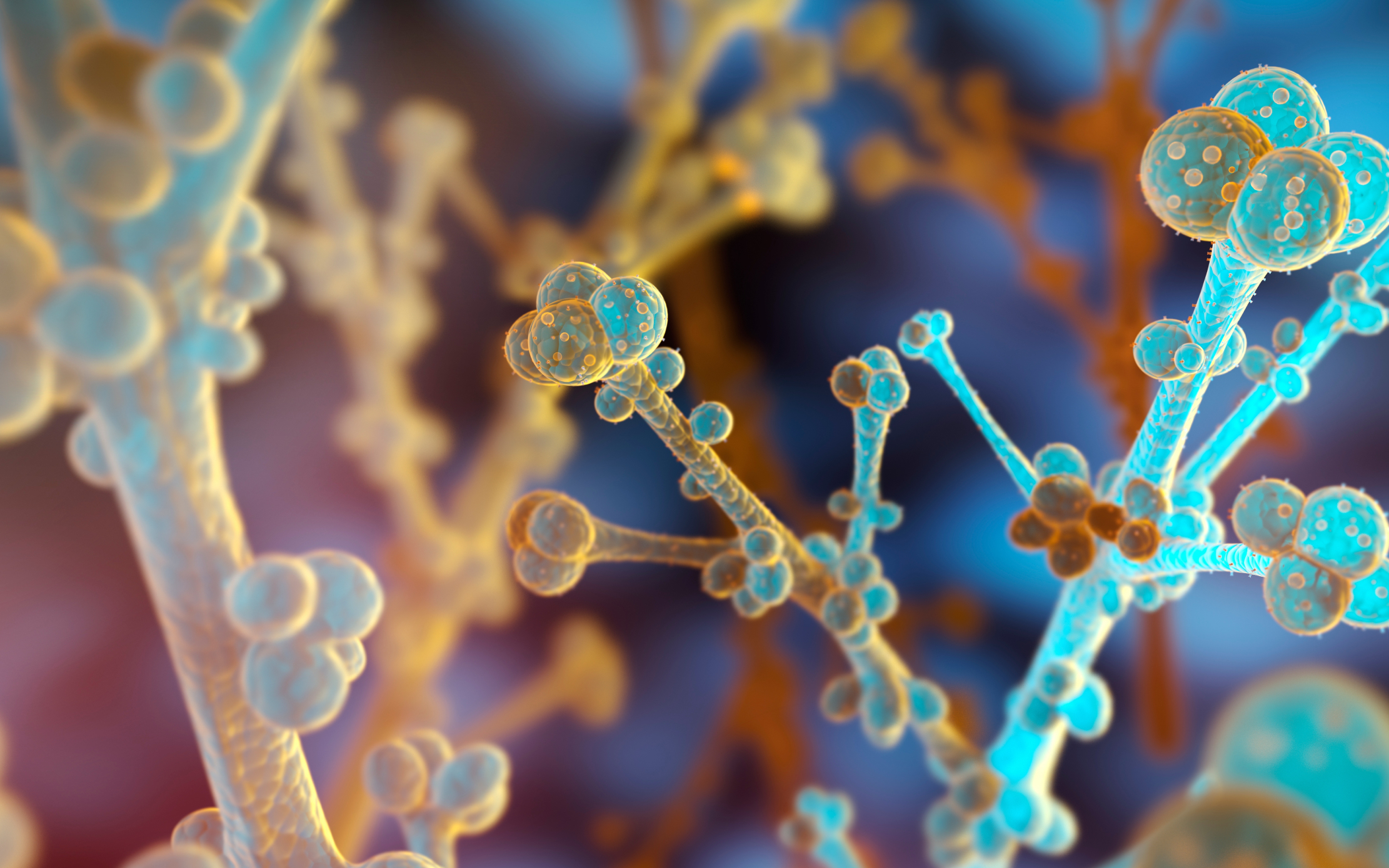
Some fungi help us make everyday foods and drinks, while others can make us ill. Among the latter are Candida species, yeasts that cause diseases ranging from oral thrush to candidemia, a life-threatening bloodstream infection. In people with weakened immune systems, even normally benign species that inhabit our skin and gut, such as Candida tropicalis, can become deadly invaders.
While potent antifungal drugs exist, they can cause collateral damage and face issues of rising drug resistance. “Because fungal cells share many similarities with ours, it can be difficult to selectively target fungi without harming patients,” explained Ning Li, a Senior Scientist at the A*STAR Infectious Diseases Labs (A*STAR IDL). “Broad-spectrum antifungals can also kill beneficial fungi within our bodies, causing other health issues.”
This issue motivated Li and colleagues from A*STAR IDL and the A*STAR Bioinformatics Institute (A*STAR BII) to develop a new, more targeted antifungal agent: Gua-SMACS-16, one of a class of compounds known as synthetic membrane-active cationic supramolecules (SMACS). This molecule consists of positively charged and water-repelling (hydrophobic) molecular groups around a rigid molecular core.
“Gua-SMACS-16 is designed to preferentially bind fungal cells, rather than mammalian ones, by exploiting differences in cell surface charges,” said A*STAR IDL Senior Principal Investigator Yue Wang.
Drawn to the stronger negative charges on fungal cell surfaces, Gua-SMACS-16’s positive groups attach to those, bypassing mammalian cells. Its hydrophobic groups then disrupt the fungal cell membrane, eventually killing the cell.
In culture studies, the team found that Gua-SMACS-16 successfully killed off C. tropicalis while largely sparing not only mammalian cells and zebrafish embryos, but closely related Candida species—C. albicans, C. auris and C. glabrata—in mixed cultures. Further experiments revealed that the key to Gua-SMACS-16’s unusual species selectivity appears to lie in β-glucan, a major component of fungal cell walls.
Like clothing shielding our skin from the environment, β-glucan helps form a protective layer around many fungal cells, keeping Gua-SMACS-16 from its target. However, the team found that C. tropicalis cell walls contain relatively less β-glucan than those of the other closely related species tested, allowing Gua-SMACS-16 to cross them more readily.
“A narrow-spectrum antifungal could offer important advantages by preserving beneficial fungi in the microbiome and reducing unnecessary exposure of other microorganisms to the drug,” said Li.
This finding also suggested a way to extend Gua-SMACS-16’s activity: when the researchers combined it with caspofungin, an existing antifungal that inhibits β-glucan production, the tag team showed exceptionally strong synergy against other Candida species, including C. auris, a fungal pathogen designated as a critical priority by the World Health Organisation.
“Caspofungin reduces β-glucan production, which may weaken cell walls and allow more Gua-SMACS-16 to reach cell membranes,” Wang noted. “Conversely, the membrane damage caused by Gua-SMACS-16 may interfere with the function of β-glucan synthase, the membrane protein targeted by caspofungin, potentially making fungal cells more susceptible to the drug.”
The team plans to optimise Gua-SMACS-16’s positive charges, hydrophobic groups and spatial arrangement to improve its performance under conditions that more closely resemble those of the human body. “We also aim to develop next-generation SMACS with greater antifungal potency, lower toxicity to mammalian cells and improved activity in serum and other physiological environments,” said Li.
The A*STAR-affiliated researchers contributing to this research are from the A*STAR Infectious Diseases Labs (A*STAR IDL) and A*STAR Bioinformatics Institute (A*STAR BII).