


Print the same photo on ten different printers, and you’ll often notice differences in their outputs. Colour hues and line sharpness might vary; there might be gaps or blots of ink. Without calibrating your printers’ settings, you’re unlikely to get prints of the same quality across the board.
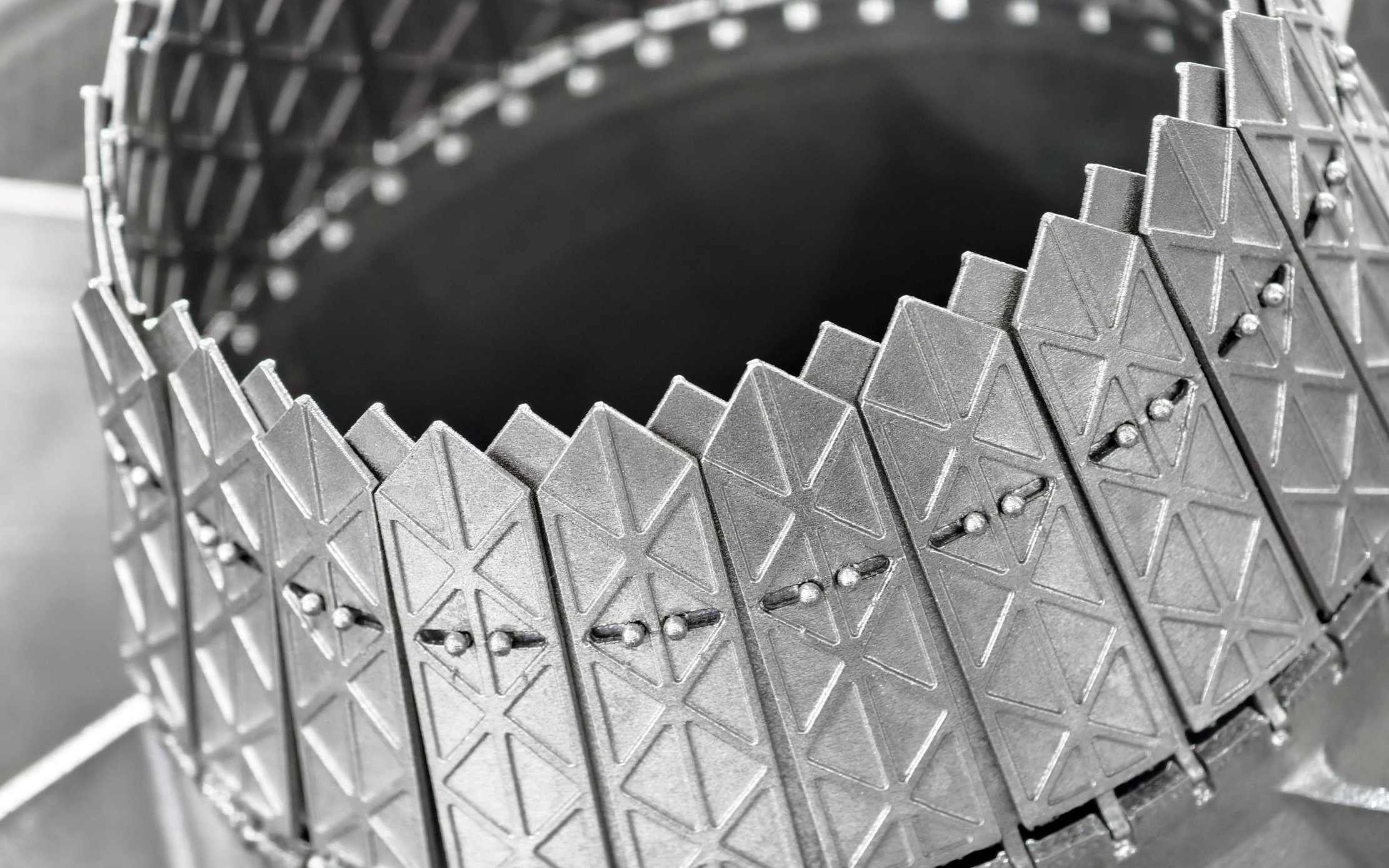
Likewise, machine settings matter in additive manufacturing (AM), where high-performance alloys such as Ti-6Al-4V can be 3D-printed into complex components. Despite the material’s excellent strength and corrosion resistance, small process variations can determine whether a vital piece of an airplane, surgical implant or reactor holds up with use and time.
“It’s critical to simultaneously achieve both high density and fine microstructure in advanced Ti-6Al-4V applications,” said Pan Wang, a Senior Scientist at the A*STAR Singapore Institute of Manufacturing Technology (A*STAR SIMTech). “High density delays fatigue crack initiation and improves long-term durability under cyclic loading; a fine microstructure provides high strength, damage tolerance and wear resistance while maintaining enough ductility.”
Electron beam powder bed fusion (PBF-EB) could help build Ti-6Al-4V parts with those ideal features. Using a near-instantly deflectable electron beam, this additive manufacturing technique builds parts in a vacuum at elevated temperatures, which minimises contamination, reduces the need for post-processing heat treatments, enables fast scanning and efficiently produces large or bulk components with consistent quality.
“However, previous studies on optimising PBF-EB for Ti-6Al-4V have produced conflicting recommendations, due to multiple parameters being tuned simultaneously, over narrow ranges, and under machine-specific conditions,” Wang noted.
To address the issue, Wang and A*STAR SIMTech colleagues collaborated with Nanyang Technological University, Singapore in a comprehensive investigation of how PBF-EB parameters affected the morphology, porosity, microstructures and mechanical properties of Ti-6Al-4V parts.
After systematically isolating the individual effects of key process parameters—scan speed, line offset, focus offset and preheating temperature—the team then varied each one independently over a wide processing window, producing over 100 distinct parameter sets.
“We showed that optimal Ti-6Al-4V fabrication requires a careful balance between sufficient fusion and microstructural refinement,” said Wang. “Excessively high energy inputs ensure good bonding but lead to microstructural coarsening, surface distortion and—in extreme cases—large spherical pores. Conversely, excessively low energy inputs refine the microstructure, but introduce lack‑of‑fusion defects that severely degrade tensile performance.”
The team consolidated their findings into a process map that identifies threshold boundaries governed by melt pool geometry and thermal behaviour, making them transferable across different PBF-EB machine systems.
“Based on our results, we recommend operating close to, but within, the good‑fusion boundary identified in the process map,” said Wang. “This means using relatively higher scan speeds combined with moderately reduced line offsets under normal preheating conditions.”
The team is now evaluating how the optimised parameters perform under real-world industrial conditions. Their approach is also being extended to other performance-critical properties and PBF-EB alloy systems, with the aim of accelerating process qualification and reducing reliance on post-processing.
The A*STAR researchers contributing to this research are from the A*STAR Singapore Institute of Manufacturing Technology (A*STAR SIMTech).


