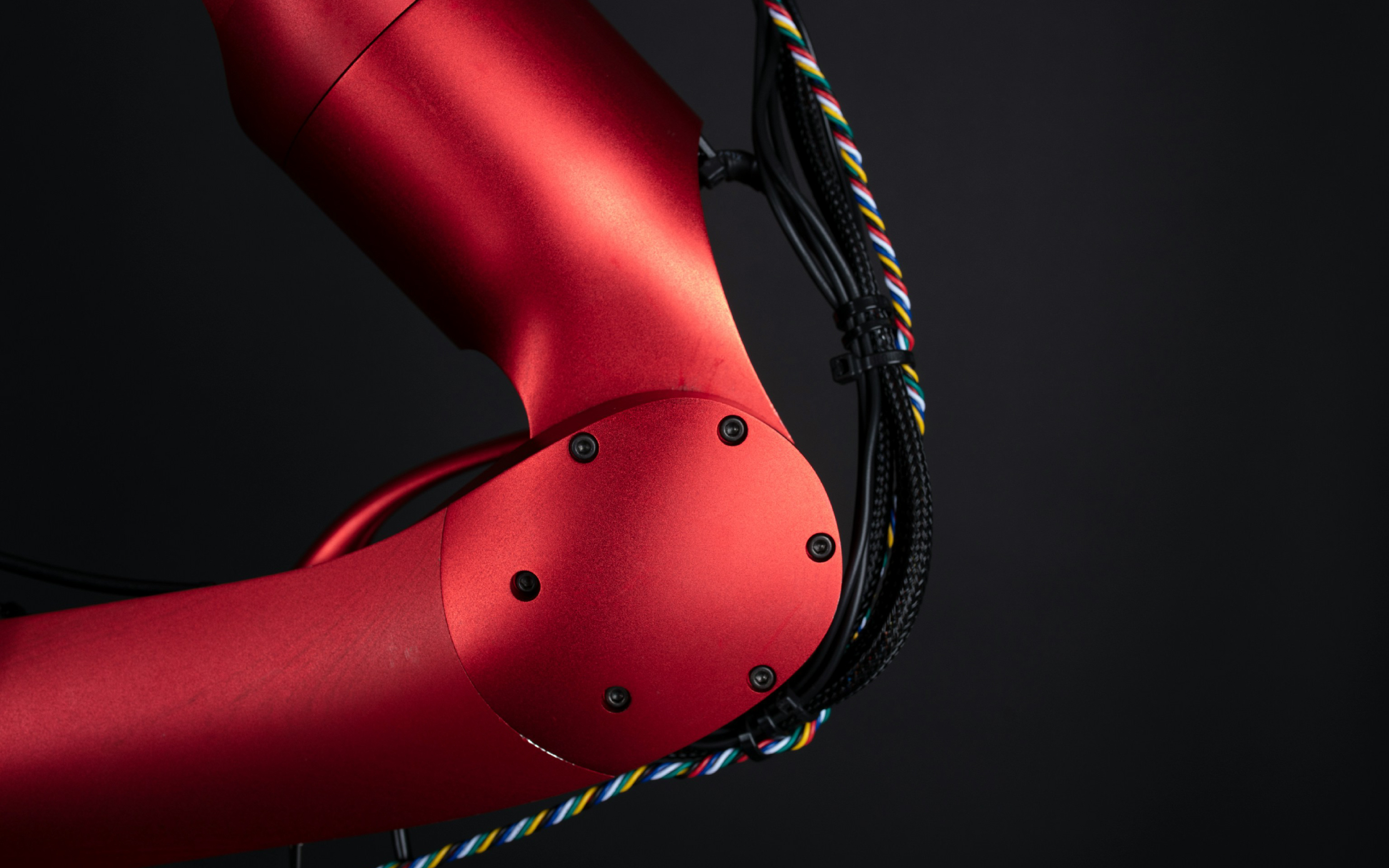
As autonomous robots transition from enclosed workspaces into those shared with human partners, balancing operational safety and task efficiency remains a central challenge. Unlike self-driving cars, robots designed to help with manual tasks can’t just be programmed to avoid collisions or keep their distance from people and objects.
“We want robots to physically interact with the real world; to cook a dish, sweep a floor, grasp objects, or pass us a cup of coffee,” said Yan Wu, Deputy Head of the Embodied AI and Robotics Chapter at the A*STAR Institute of Advanced Intelligence and Computing (A*STAR IAIC). “None of these tasks can be achieved if safety simply means ‘never make contact’.”
Wu added that robotic safety should encompass two sides of the same coin: a robot should be able to actively avoid collisions when contact is undesirable, while also reacting appropriately to intended, unavoidable or unexpected physical contact.
To address the issue, Wu, Xinyuan Zhao and colleagues from A*STAR IAIC—formerly the A*STAR Institute of Infocomm Research (A*STAR I2R)—recently developed a harmonised robotic controller framework that incorporates both active and passive safety mechanisms.
Under the team’s framework, the active system uses control barrier functions and fallback safety actions to avoid collisions with detected obstacles. Meanwhile, the passive system mitigates post-collision impacts by monitoring the robot’s energy levels and limiting power exchanges, helping it react compliantly to unexpected interactions, such as a human hand touching it or moving in its way.
Combining these two paradigms, however, can present a major stability hurdle. Previous research shows that switching between active and passive responses mid-task often causes robots to become erratic or lose control.
To resolve this, the team integrated an ‘energy tank’ model into their framework to act as a regulated virtual reservoir. When the robot performs active avoidance actions, it draws energy from the tank; when physical contact occurs, the controller uses the remaining energy reserves to smoothly modulate the robot’s softness, preventing instability.
Zhao noted that while energy tank models are not new, conventional versions come with a major catch: robots often run out of energy before finishing long tasks, yet constantly recharging the tank mid-operation also risks triggering erratic, out-of-control movements. As such, the team identified specific equilibrium states where the robot could safely recharge its tank without risking instability.
“With our proposed framework, a robot can adapt its energy budget during long-running tasks, which is particularly useful for dynamic environments involving humans, dynamic objects and unexpected events,” Zhao explained.
In validation tests with a commercially available robotic arm designed for pick-and-place tasks, the team found that the framework helped the arm generate successful responses to obstacle avoidance scenarios, direct human interactions and unexpected collisions, with adaptable degrees of stiffness and compliance.
The researchers are now looking to extend their integrated framework into broader tasks, environments and human-robot interaction scenarios. “With smarter and more robust safety frameworks, we believe that robots will become our intelligent partners, working closely and naturally alongside us in different aspects of daily life,” Wu added.
The A*STAR-affiliated researchers contributing to this research are from the A*STAR Institute of Advanced Intelligence and Computing (A*STAR IAIC).