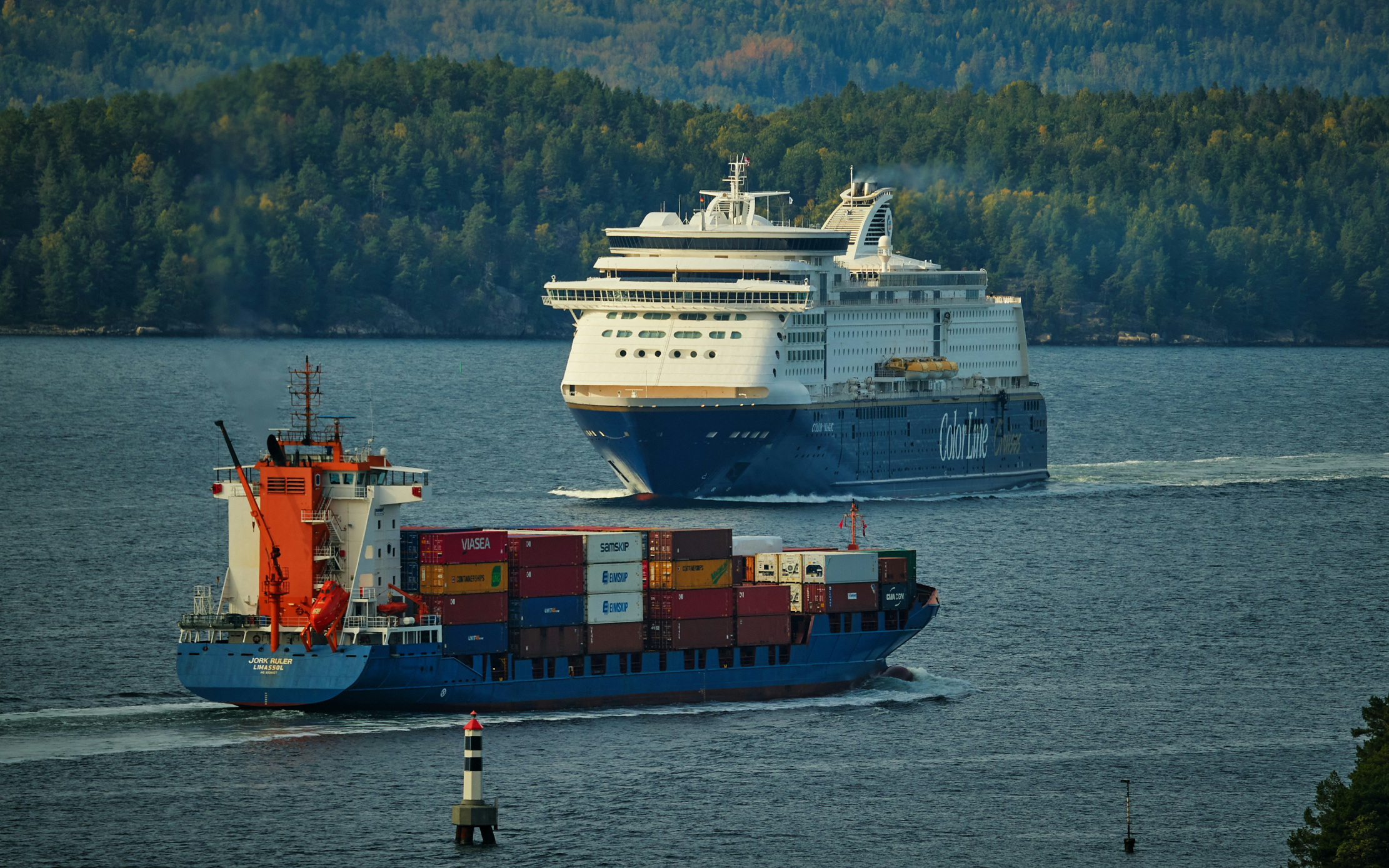
When two ships collide at sea, the incident often goes on record. An unusual number of accident reports from a certain waterway draws the attention of authorities and maritime operators. Such numerical data is an essential part of maritime risk studies that boost operational safety for all at sea.
However, that data can be too sparse to be useful. “The problem is that traditional maritime risk studies rely on records of actual collisions, but these are relatively rare events, especially in well-regulated waterways,” said Liangbin Zhao and Jiaxiang Cai, Senior Scientists at the A*STAR Institute of High Performance Computing (A*STAR IHPC). “This means there are often too few cases on which to perform detailed statistical analyses.”
To address the issue, Zhao, Cai and A*STAR IHPC colleagues recently tested a novel statistical framework for maritime risk assessment: the Binomial test for Risk Analysis Involving Near misses (BRAIN). Developed with the support of the Singapore Maritime Institute Maritime under its Artificial Intelligence Research Project, BRAIN draws on a wider pool of maritime incident data: near-misses and close encounters between vessels.
“Close encounters—where two vessels pass each other within a predefined safety threshold—are often identified automatically from automatic identification system (AIS) data,” explained Zhao. “Near-misses are a serious subset of close encounters where collisions were narrowly avoided, as indicated by late evasive manoeuvres, abnormal turning behaviour, communication difficulties, misunderstandings between vessels or other signs.”
BRAIN works by identifying close encounters from AIS traffic data, then using expert review and data analysis methods to highlight genuine near-miss events. It then calculates how frequently close encounters turned into near-misses under different conditions, such as vessel features, time of day and spatial distribution. These groups are then statistically compared against an overall average.
In collaboration with local maritime authorities, the researchers validated the BRAIN framework on a real-world historical dataset from a busy narrow section of the Singapore Strait, documenting 40,653 close encounters and 84 near-miss incidents over two years.
“We made several interesting findings. Bulk carriers showed significantly above-average risk; close encounters involving them were around 1.5 times more likely to become near-misses,” said Cai. “Nighttime operations were also noticeably more dangerous than daytime—especially during the period between midnight and 4 am. This likely reflects the reduced visibility and higher crew fatigue of overnight operations.”
Certain traffic convergence zones also emerged as clear risk hotspots: areas where vessels from multiple directions came together in relatively disordered traffic patterns showed much higher near-miss risks than more structured traffic areas.
The team aims to extend BRAIN toward real-time operational use, potentially supporting live traffic monitoring. They also aim to incorporate weather conditions, traffic management interventions, human factors, vessel communication patterns and other contextual factors into the framework.
“We’re also interested in integrating BRAIN with intelligent maritime systems and decision-support tools so that near-miss analysis can support proactive safety management, rather than retrospective investigation,” said Zhao.
The A*STAR researchers contributing to this research are from the A*STAR Institute of High Performance Computing (A*STAR IHPC).