


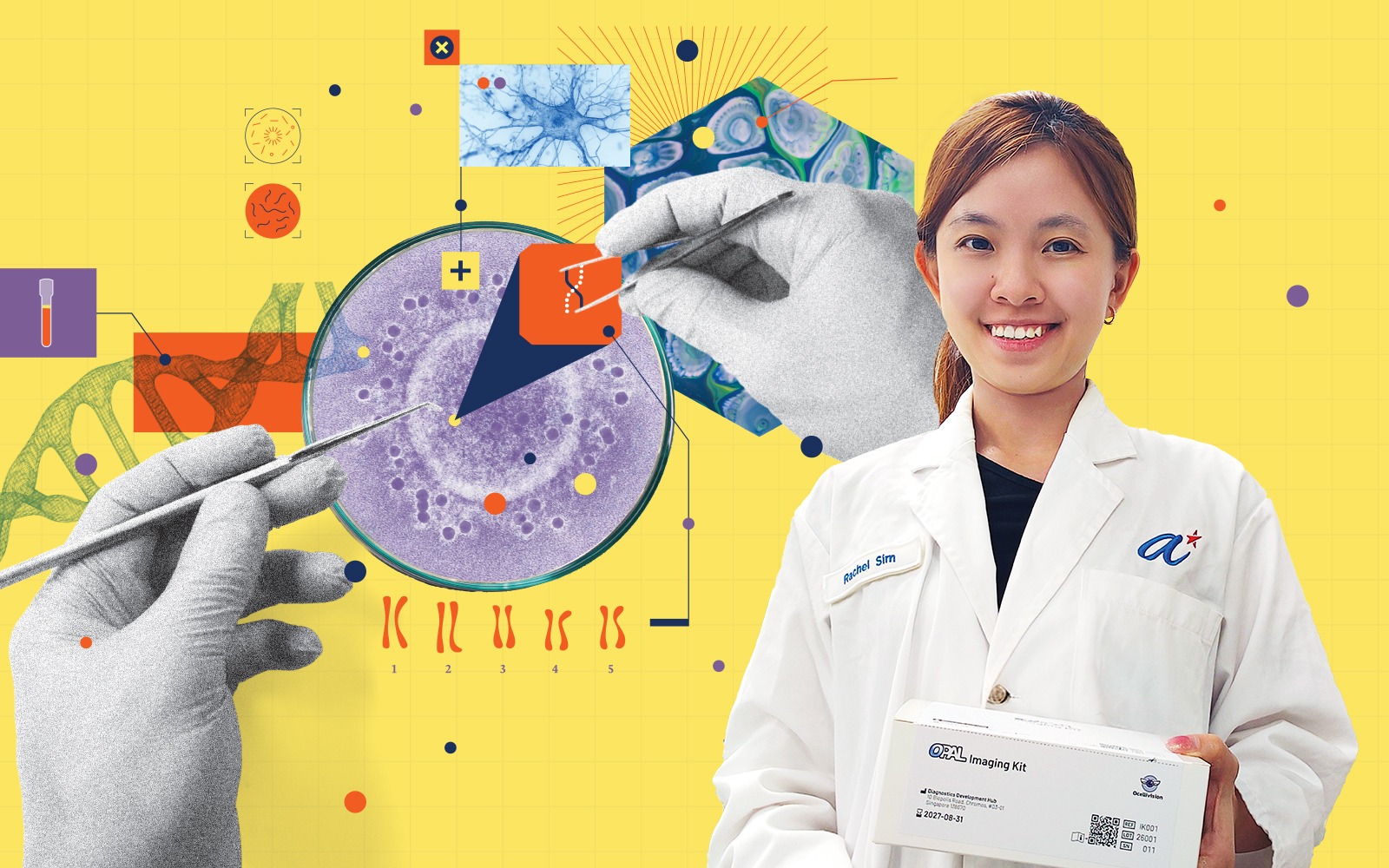
A fresh pair of eyes can often spark new insights. In the lab, different perspectives can inspire new ways to tackle age-old problems. In the clinic, a second opinion can bring clarity to complex diagnoses.
For Rachel Sim, the question is whether entirely new ways of seeing disease could help doctors make better decisions during surgery.
These cross-consultations are common—and often necessary—such as when surgeons send tissue samples to pathologists for analysis. There, definitive clinical diagnoses emerge from careful microscopic examination of tissue organisation, cell morphology and disease-related protein markers.
While these histological evaluations are essential after surgery, Sim, a Scientist at the A*STAR Institute of Molecular and Cell Biology (A*STAR IMCB) and co-founder of medtech startup Ocellivision, believes similar information could also guide surgeons while an operation is still underway.
Also an A*STAR National Science Scholarship recipient, Sim’s background in medicinal chemistry led her towards understanding the workings of fluorescent probes. A powerful tool in modern microscopy, these probes are simultaneously precision targeting devices and flashing neon signs; they latch onto target molecules and light up at specific wavelengths, allowing scientists to visualise molecules and cells across time and space.
In this feature, Sim shares how such probes and novel imaging systems could bring fresh insights during critical surgeries, and reflects on her journey navigating the space between academia and Singapore’s startup ecosystem.
1. How did your scientific journey lead you to your current research?
I have long been fascinated by the relationship between molecular structure and biological function. During my undergraduate training in medicinal chemistry, I was drawn to the idea that small molecules could influence biological systems in precise and powerful ways. Over time, my interests expanded beyond therapeutics to explore how these molecules could also serve as diagnostic tools to visualise and interrogate biology.
This curiosity eventually led me into fluorescence imaging and microscopy. I became increasingly interested in how chemistry and optical technologies could be combined to create new ways of ‘seeing’ disease. For many cancers and neurodegenerative disorders, pathology remains the gold standard for diagnosis, yet there is often a gap between what is seen during surgery and what can be confirmed histologically. I found myself asking: can we bring microscopic-level information closer to the point of care?
Today, my research at A*STAR IMCB and Ocellivision is driven by the vision to transform how diseases are detected and characterised by building novel imaging platforms that bridge the molecular and clinical worlds.
2. How did A*STAR’s National Science Scholarship support your development?
The scholarship provided me with the opportunity to pursue interdisciplinary training at world-class institutions while being exposed to diverse research environments and scientific cultures. In addition to broadening my perspective, the experience also helped me build a strong network of collaborators and mentors who continue to influence my work today.
Importantly, being an A*STAR scholar meant I was embedded within the agency’s research ecosystem early in my career. I benefited greatly from the guidance of senior researchers and from engaging with multidisciplinary teams that actively encouraged translational thinking. This environment shaped how I approach science—not as isolated discoveries, but as components of a larger innovation pipeline that can translate research into clinical or industrial applications.
Upon returning to A*STAR after completing my PhD degree, I was also given the opportunity to design and lead my own research projects. This allowed me to grow not only as a scientist but also as a leader, with a stronger focus on translating discoveries into solutions that have real-world impact. That experience further reinforced my interest in bridging fundamental research with clinical and technological applications.
3. How might your interdisciplinary research at A*STAR lead to clinical impact?
My work sits at the intersection of chemical probe development, optical imaging and translational medicine. At A*STAR IMCB, we focus on developing molecular imaging platforms that combine fluorescent probes with optical systems to generate actionable biological insights.
For example, our team recently generated fluorescent probes to detect pathological protein aggregates in neurodegenerative diseases. By combining chemical design with biological validation, we demonstrated selective detection of disease-associated aggregates in both brain and intestinal tissues. Such molecular tools could expand our understanding of disease progression and potentially enable earlier detection strategies.
Meanwhile, we are also developing high-resolution imaging systems for cancer surgery by integrating optics engineering, probe chemistry and biological validation. Developing these platforms requires close collaboration with partners across multiple disciplines—from the chemists designing the probes, to the engineers building the optical systems, to the clinicians helping to evaluate how these tools might work in surgical settings.
Our imaging system aims to deliver histology-like information in real time during operations, potentially supporting surgical decision-making. We also work closely with our clinical partners to evaluate prototypes on patient tissues, which keeps our work grounded in real-world needs.
4. What do you hope to achieve through Ocellivision?
Ocellivision was founded on a simple but powerful observation: while pathology provides definitive diagnosis, it is often separated in time and space from the surgical procedure itself. Surgeons frequently make critical decisions without comprehensive access to microscopic-level information at the point of care.
Our team saw an opportunity to bridge this gap by developing an imaging platform that provides high-resolution, histology-like information during surgery. This real-time tissue assessment, we hope, can ultimately improve patient outcomes. More broadly, our ambition is not just to make incremental improvements, but to rethink how tissue assessment can happen intraoperatively: bringing microscopic insights directly into the operating theatre.
Through Ocellivision, we are translating years of research in optical imaging and probe development into a clinically deployable system. We aspire to build a company that remains rooted in scientific rigour while being responsive to clinical needs. Beyond product development, our goal is to contribute to a broader ecosystem in Singapore where deep science can evolve into impactful medical technologies.
5. What is life like as a medtech startup founder?
In academia, the focus is on discovery and validation. As a founder, however, one must also consider regulatory strategy, manufacturing, finances and personnel development. The guiding question shifts from ‘Is this scientifically interesting?’ to ‘Can this solve a defined problem in a sustainable way?’
As we move closer to translating research into a product, the scope of considerations expands significantly. We must think about regulatory strategy, manufacturing pathways, reimbursement frameworks, fundraising and team building—all while ensuring that the science remains robust and clinically relevant.
While Singapore offers strong institutional support and access to translational grants, medtech development is inherently complex and timelines are long. Resilience and perseverance are essential, particularly when navigating the technical, regulatory and financial challenges that come with bringing new medical technologies to the clinic.
That said, it has been an incredibly meaningful journey thanks to the multidisciplinary team of engineers, clinicians and scientists that we work with. Despite the challenges, our team remains united by a shared mission. Seeing our science move closer to real-world application makes the effort deeply gratifying.
6. What advice would you like to share for aspiring scientific entrepreneurs?
First, engage end users early. Whether in healthcare or other fields, understanding real-world workflows and constraints is critical. Technologies developed with these real-world needs in mind are far more likely to be adopted and have lasting impact.
Second, be adaptable. Many new discoveries and setbacks will arise along the way. Amid these challenges, the ability to respond constructively to change and pivot when necessary is essential.
Most importantly, enjoy the journey!


