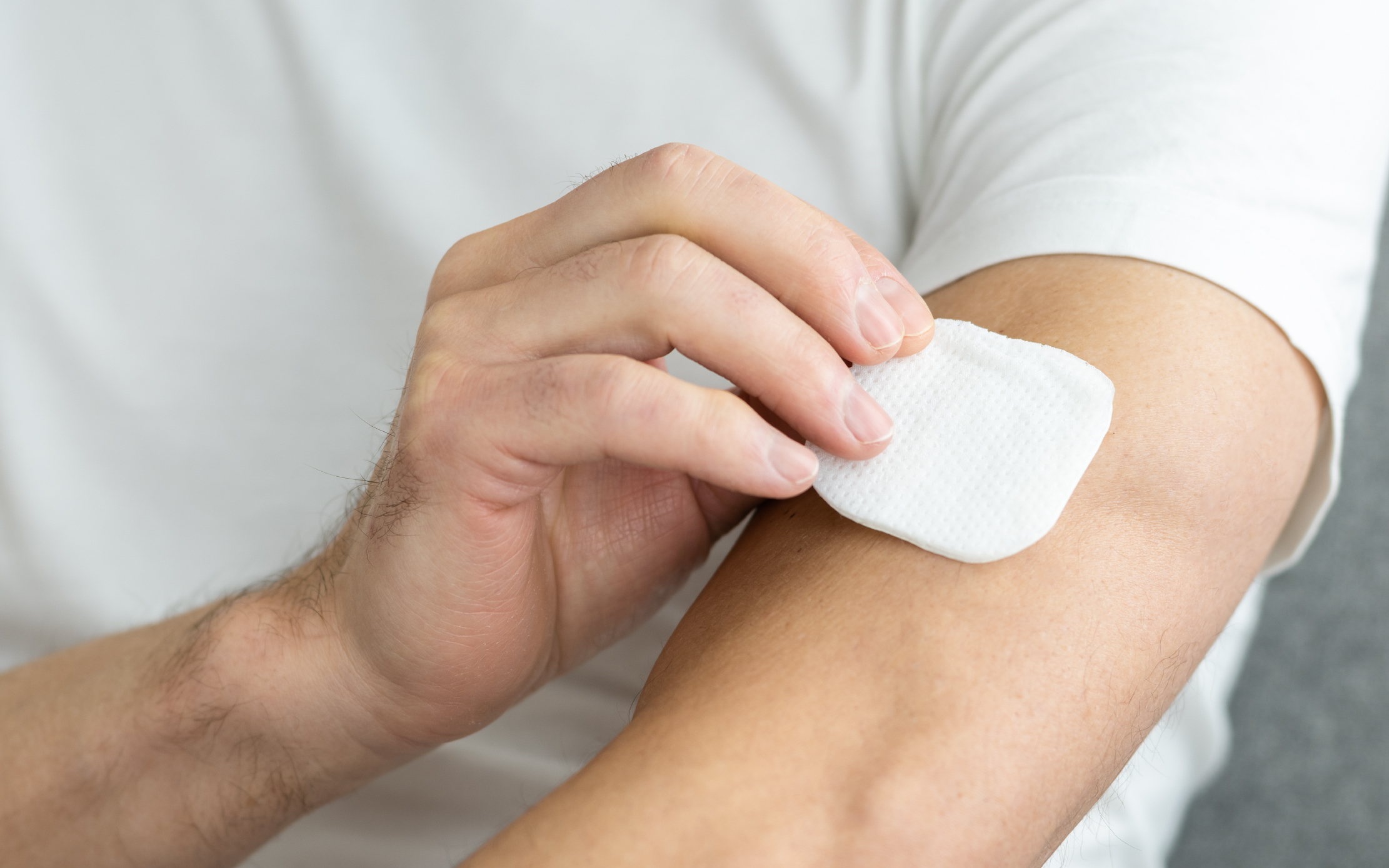
For those of us harbouring a fear of needles, receiving painless injections that feel like nothing more than a mosquito bite would be a huge relief. Microneedles could make this a reality.
“Compared with traditional syringe needles, microneedles offer minimal invasiveness, high patient compliance and reduced risk of infection,” said Ki Hyun Bae, a Principal Scientist at the A*STAR Bioprocessing Technology Institute (A*STAR BTI). They can be designed as tiny patches for transdermal delivery, providing drugs and vaccines through the skin for direct absorption into the bloodstream.
However, the technology has yet to receive approval for medical use from health authorities globally. Hyaluronic acid microneedle array patches (HA-MAP), for example, face major challenges in insufficient tip-loading and unstable protein cargo. “Only small doses can be delivered due to the tips’ limited volume. As proteins are prone to degradation in different environments like room temperature conditions, preserving their activity remains a critical roadblock in the clinical translation of microneedle patches,” explained Bae.
To tackle these limitations, Bae teamed up with Kun Liang, an Assistant Professor at the Lee Kong Chian School of Medicine, Nanyang Technological University and Principal Scientist at A*STAR Skin Research Labs (A*STAR SRL); as well as colleagues from the A*STAR Institute of Molecular and Cell Biology (A*STAR IMCB); and Skin Research Institute of Singapore (SRIS). The researchers hypothesised that introducing a polymeric microgel could help concentrate the protein in the tips, using a micromoulding process to combine Dex-HPE microgel and hyaluronic acid into a microgel-integrated microneedle array patch (MI-MAP).
The microgel’s phenolic dimers, which are two linked units of a highly stable chemical ring structure, can capture the protein via strong protein-phenolic interactions, explained Bae. These interactions not only localised the protein to the microneedle tips but also enhanced their stability even when stored at room temperature.
“Excitingly, we saw that MI-MAP significantly outperformed conventional microneedles in terms of tip-loading capacity and transdermal delivery performance,” said Bae.
The researchers tested MI-MAP’s tip-loading capacity using a sample with fluorescent labels to visualise the relative amount of protein content. Compared to conventional microneedles, MI-MAP showed a seven-fold increase in fluorescence intensity. Furthermore, MI-MAP shielded its protein cargoes from degradation almost twice as effectively as HA-MAP at room temperature.
The team then shifted focus to checking whether such improvements in tip-loading and protein stability led to better drug delivery. MI-MAP exhibited a nearly 10-fold greater transdermal delivery performance over conventional counterparts in a pig skin model mimicking the structure and function of human skin. In mice, SARS-CoV-2 protein subunit vaccines delivered via MI-MAP also promoted a more rapid protective response and growth of antibody-producing immune cells compared to HA-MAP.
Bae and colleagues are now developing microneedle patches for improving the delivery of mRNA vaccines and therapeutics across skin and mucosal barriers, with hopes of pushing such innovations into mainstream use in the future.
The A*STAR-affiliated researchers contributing to this research are from the A*STAR Bioprocessing Technology Institute (A*STAR BTI), A*STAR Institute of Molecular and Cell Biology (A*STAR IMCB) and A*STAR Skin Research Labs (A*STAR SRL).