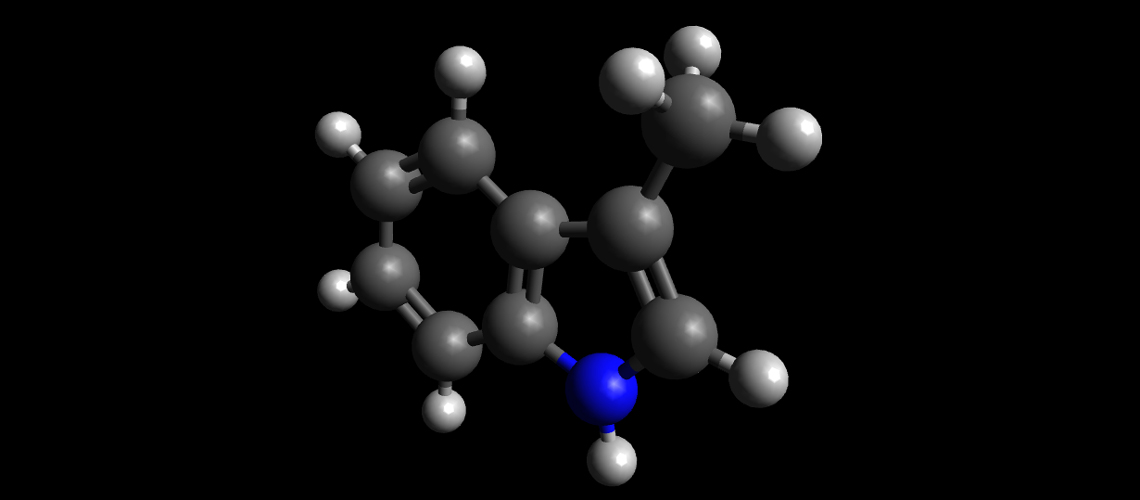
The malodorous molecule that gives animal manure its repugnant stench has been tracked to its source. A*STAR researchers and their colleagues have identified the enzyme that certain gut bacteria use to produce skatole, a characteristic component of fecal aroma. The discovery could potentially be used to help eliminate offensive smells from animal farming, and it might even have implications for improving human health, the researchers say.
Skatole is so potent that the human nose can detect it in the air at a concentration threshold of just 0.00056 parts per million. Bacteria living in the gut of animals, including humans, produce skatole by breaking down indoleacetate, which is itself a breakdown product of tryptophan, an amino acid from dietary protein. The bacterial enzyme that converts indoleacetate into skatole has never been identified, although the enzymes that break down related aromatic amino acid metabolites are known.
Now, the skatole-producing enzyme has been identified by an international research team, co-led by Huimin Zhao, from the A*STAR Institute of Chemical and Engineering Sciences. “We are interested in identifying new enzyme-catalyzed chemical reactions in nature, and exploring the corresponding enzymes for practical applications,” said Zhao.
The team used comparative genomics to identify the enzyme responsible. “We were fortunate that the genome sequences of two skatole-producing bacteria were already available in public databases,” adds Yifeng Wei, a member of Zhao’s team at A*STAR. The researchers compared the genes of the two bacteria, looking for unknown enzymes that both species possessed, related to enzymes known to break down other aromatic amino acid metabolites.
The team quickly identified a candidate enzyme in the genetic data, and a biochemical assay confirmed it turns indoleacetate into skatole. Away from the oxygen-free environment of the gut, the indoleacetate decarboxylase enzyme required careful handling. “The most challenging part of this project – conducted mainly by our collaborators in Tianjin University was the biochemical characterization of the oxygen-sensitive enzyme,” Zhao says. To ensure it remained active, the enzyme had to be kept and handled in a glove-box, under oxygen-free conditions, at all times.
Identifying indoleacetate decarboxylase has many potential practical applications, Zhao says. The enzyme’s genetic sequence can be used as a marker to identify skatole-producing organisms. “Once identified, steps can be taken to eliminate or replace these organisms, or to create conditions that suppress their specific skatole-producing metabolism,” Zhao says. The applications extend far beyond agriculture. “We noticed that this enzyme is present in certain sequenced human oral bacteria, which could provide an avenue to treat certain aspects of bad breath,” adds Wei. The mosquitoes that carry human diseases such as Japanese encephalitis and West Nile virus are also known to be attracted by skatole.
Comparative genomics has the potential to identify many other enzymes with unusual chemistry and biochemistry, Zhao says. “There are numerous metabolites produced by anaerobic bacteria, particularly gut bacteria, that can only be produced by unusual and as-yet unidentified enzyme chemistry,” he says. The gut, an oxygen-free anaerobic environment, is potentially a rich source of enzymes possessing unique biochemical reactivity involving highly reactive ‘free radical’ intermediates.
“As biochemists, we are used to thinking of organic molecules in which all electrons are paired up,” says Zhao. “However, certain reactions are more easily accomplished through chemical species with unpaired electrons – that is, free radicals.” These reactive species are often sensitive to oxygen, but that is no impediment in the gut.
The team next plans to study the free-radical mechanism for indoleacetate decarboxylation in more detail, and characterize other enzymes in the skatole-producing metabolic pathway, Zhao says. “In the long-term, we plan to continue discovering new enzymatic free radical chemistry in environmental and human gut bacteria.”
The A*STAR-affiliated researchers contributing to this research are from the Institute of Chemical and Engineering Sciences. For more information about the team’s research, please visit the Metabolic Engineering Research Lab webpage.