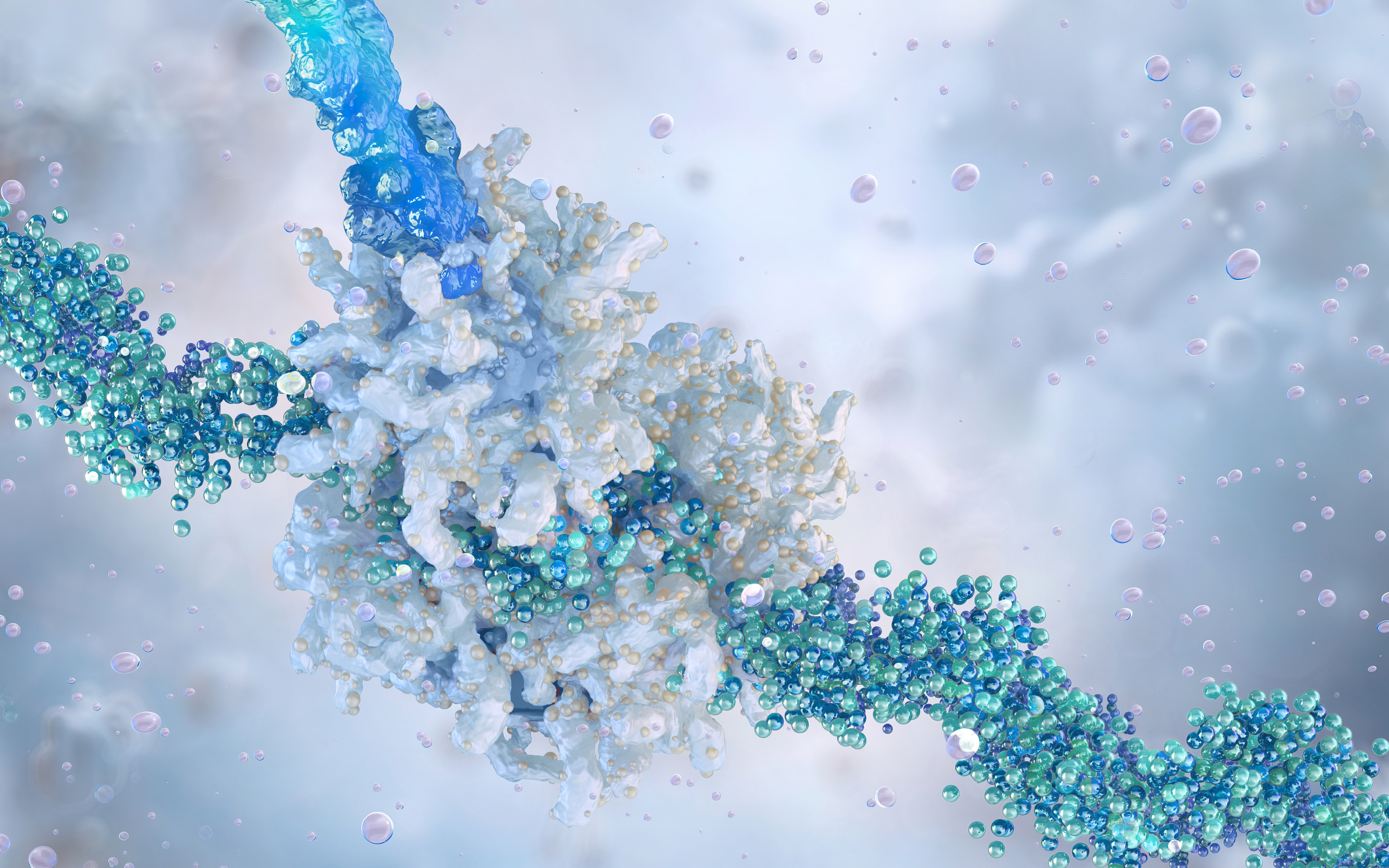
Imagine if we could design tiny biological machines that could not only spot genetic disease markers inside our cells but also activate a solution to the problem. A first-in-class RNA-based molecular tool named UNBAR (UNlocked by Activating RNA) might just enable that prospect, offering researchers and clinicians a versatile, all-in-one platform with which to build highly specific nanomachines that can function simultaneously as gene detectors, signal amplifiers and editors.
“UNBAR is a catalytic RNA molecule, or ribozyme, with two features on a single strand: a trigger-binding domain designed to base-pair with a specific RNA sequence, and a pair of cleavage sites flanking an RNA product,” explained Sherry Aw, a Principal Scientist at the A*STAR Institute of Molecular and Cell Biology (A*STAR IMCB). “When an RNA sequence of interest binds to UNBAR, it acts like a key, causing UNBAR to self-cleave and release its RNA product.”
Developed by A*STAR IMCB and investigated in collaboration with the A*STAR Bioinformatics Institute (A*STAR BII) and the National University of Singapore, UNBAR is highly modular, as both its trigger-binding domain and cleavage product can be independently modified. This makes the platform adaptable to a wide range of inputs and outputs; for example, an UNBAR ribozyme could be designed to detect an RNA sequence unique to a specific virus, and release an antiviral RNA tailored to it.
“While there are other molecular switches for RNA signal transduction, they’re typically sequence-restricted, with their sensing and actuation regions comprising competing base pairs,” said Aw. “However, UNBAR’s sensing and actuation domains are separated from each other, allowing true modular and programmable signal transduction.”
In a recent experimental study describing this new system and its capabilities, Aw and colleagues, including former A*STAR IMCB Senior Scientist Mandy Lim, A*STAR IMCB Scientist Charannya Sozheesvari Subhramanyam, and A*STAR Graduate Academy (A*GA) PhD student Chermaine Tan, showed that UNBAR ribozymes could perform cell-free sensing and protein-free amplification of microRNA and viral RNA sequences, as well as trigger-dependent release of non-coding RNA effectors.
“We were also excited to find that trigger-bound UNBAR ribozymes can cleave trigger-unbound ones,” Aw added. “This means the platform itself can function as a signal amplifier, which isn’t a feature of most other molecular switches.”
To demonstrate UNBAR’s capabilities, the team engineered several ribozymes, including one that triggered fluorescent outputs when it detected a specific RNA sequence. Another design was able to regulate CRISPR-Cas9 gene editing within zebrafish embryos and human cells.
The team is currently working to improve UNBAR’s signal amplification rate. Currently, standard UNBAR cleavage assays take around four hours.
“We’re excited about UNBAR’s potential applications in next-generation precision RNA therapeutics, as it could be used for cell-context-specific gene regulation based on sensing and transducing RNA disease markers or cell-type-specific markers,” said Aw. “Our platform opens up many novel directions for RNA-based detection and genetic circuit control.”
The A*STAR affiliated researchers contributing to this research are from the A*STAR Institute of Molecular and Cell Biology (A*STAR IMCB) and the A*STAR Bioinformatics Institute (A*STAR BII).